Technique and methods
The Snatch Technique of World Record Holder Yu. Zakharevich
English summary of Tyazhelaya Atletika. Ezhegodnik 1983 (Moscow: Fizkultura i Sport, 1983), pp. 10–16: the text is paraphrased, not translated; data tables are given in full with English labels; figures are the original images.
Material
Film analysis of three snatches by Yu. Zakharevich (100 kg class; height 178 cm, foot 28 cm): 188 kg (1st attempt, record), 192.5 kg failed (2nd) and 192.5 kg world record (3rd). Frames refer to the film sequence, positions to Figs. 1–2; phase times, speeds, angles and bar positions are in Tables 1–5.
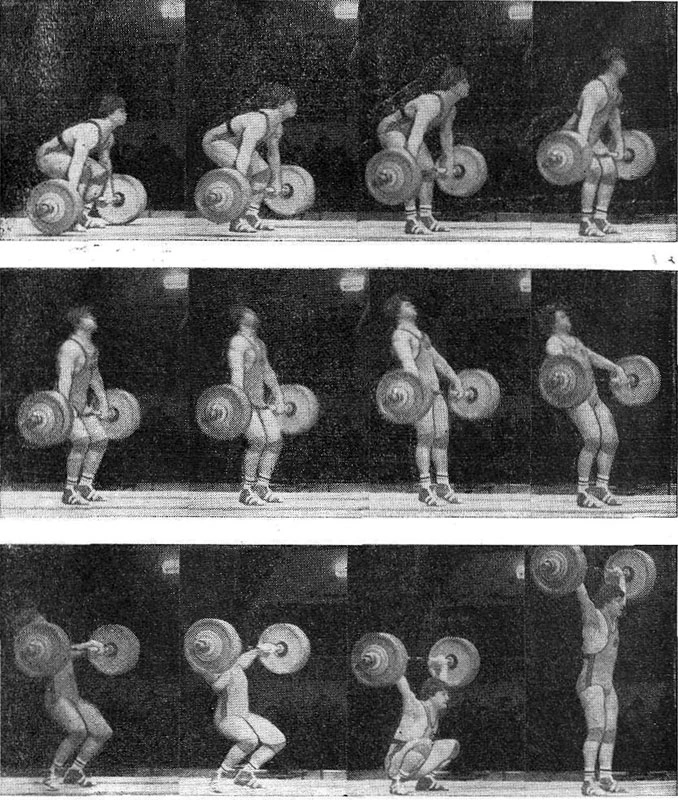
The 192.5 kg record lift
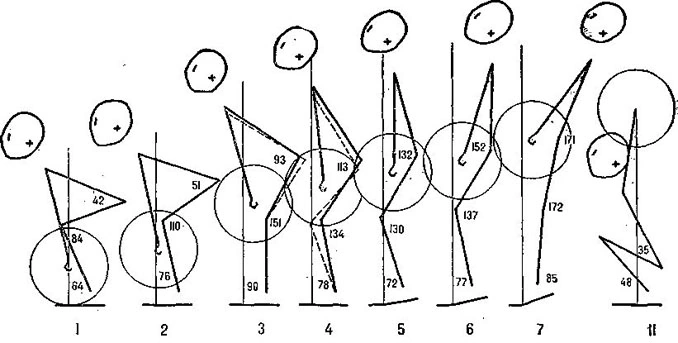
- Start: feet two foot-widths apart, toes slightly out, bar over the metatarsophalangeal joints; hips above knees; trunk 22°, shoulders ahead of the bar, head upright, narrow grip; hips 42°, knees 84°, shins 64°.
- First pull (0.5 s incl. lift-off): at 10 cm the trunk is most inclined (17°; knees 110°, hips 51°) and the bar 2 cm closer. His shoulders go up and 3 cm back, then vertically — not in the usual forward arc. At the end: shins vertical, hips 93° (others ≈ 85°), bar just above the knees and 6.5 cm closer.
- Knee rebend (0.08 s, whole foot): trunk extension drives knees forward; ends with hips 113°, bar at mid-thigh over mid-foot, shoulders 6 cm ahead of it.
- Explosion (0.17 s): body straight and leaning back at the end. The trunk extends faster than the legs, so the bar moves up and back onto the lifter more than is optimal.
- Squat under: the arms pull the body under; feet stay down 0.06 s, then move sideways and 15 cm back during a 0.14 s flight while the bar still rises. In the low squat: trunk 61°, knees 22°, shins 48°. The bar path ends in a downward loop; he rises with hips up and shoulders forward (frame 12).
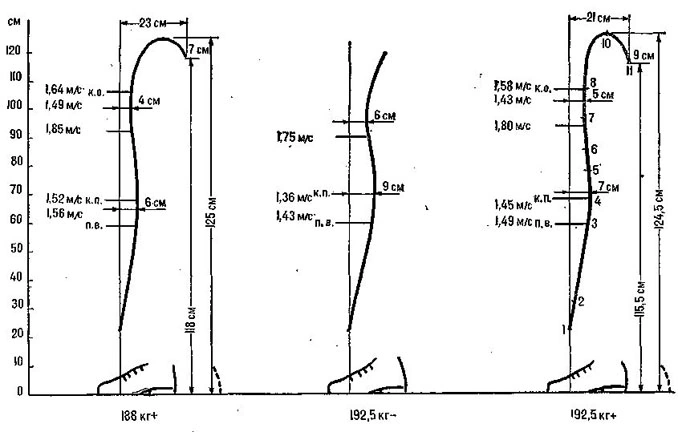
Comparison of the three attempts
Table 1. Duration of the phases (s)
| Barbell, kg | Until the bar leaves the platform | First phase of the pull | Knee rebend | Explosion | Support after explosion | Unsupported phase | Absorption phase | Total time |
| 18*+ | 0.13 | 0.33 | 0.08 | 0.17 | 0.06 | 0.19 | 0.29 | 1.25 |
| 192.5– | 0.15 | 0.42 | 0.08 | 0.17 | abandoned the lift | |||
| 192.5+ | 0.13 | 0.37 | 0.08 | 0.17 | 0.06 | 0.14 | 0.33 | 1.28 |
* The source prints “185+”; the text, Fig. 1 and Tables 2–5 all give this attempt as 188 kg, so the last digit is evidently damaged (read 188).
Table 2. Bar speed in the phases (m/s)
| Barbell, kg | After full leg extension | During knee rebend | In the explosion | At the end of support | After pushing off the platform |
| 188+ | 1.56 | 1.52 | 1.85 | 1.49 | 1.64 |
| 192.5– | 1.43 | 1.36 | 1.75 | abandoned the lift | |
| 192.5+ | 1.49 | 1.45 | 1.80 | 1.43 | 1.58 |
Table 3. Joint angles at the boundary positions (degrees)
| Barbell, kg | After full leg extension | After the knee rebend | ||||
| ankle angle | knee angle | trunk to platform | shin to platform | knee angle | trunk to platform | |
| 188+ | 90 | 153 | 32 | 80 | 137 | 54 |
| 192.5– | 90 | 151 | 34 | 74 | 131 | 59 |
| 192.5+ | 90 | 151 | 32 | 78 | 134 | 55 |
For the successful 192.5 kg lift the article text gives the trunk angle after the knee rebend as 57°; the table prints 55°.
Table 4. Bar position in the phases (cm)
| Barbell, kg | Height after full leg extension | Approach to the lifter in the first phase of the pull | Height at end of knee rebend | Height at maximum speed in the explosion | Shift towards the lifter after the explosion, relative to start | Height at end of foot support after the explosion |
| 188+ | 59 | 6 | 68 | 92 | 4 | 106 |
| 192.5– | 60 | 9 | 70 | 90 | 6 | |
| 192.5+ | 59 | 7 | 68 | 93.5 | 5 | 106 |
Table 5. Bar parameters in the phases (cm)
| Barbell, kg | Maximum bar height | Depth of the absorption in the squat | Height of fixation in the squat | Shift of the bar towards the lifter at fixation, relative to start | Backward shift of the feet | Bar centre of gravity from the heel edge |
| 188+ | 125 | 7 | 118 | 23 | 18 | 15 |
| 192.5+ | 124.5 | 9 | 115.5 | 21 | 15 | 14 |
The original prints this table simply as “Table”, without a number; it is the fifth in the series.
Findings
- First pull: the same height in all attempts but different times, so the fastest pull (188 kg) had the highest speed and the slowest (the miss) the lowest. Compared with other lifters (knee ≈ 145°, trunk 30° at the end), he extends the knees more and leans slightly less.
- Short knee rebend — a hallmark of his technique: the knee angle falls 16–17° in the good lifts, 20° in the miss, against about 25° in others; bar speed drops only 0.04 m/s (0.07 in the miss).
- Explosion: with equal time (0.17 s), the good lifts covered a longer path (24 and 25.5 cm vs 20), hence higher take-off speed. Momentum alone would carry the bar only 17.5, 15.5 and 16.5 cm further (to 109.5, 105.5 and 110 cm), short of the 124.5 cm he needs.
- Where the extra height comes from:
- After the explosion lifters stay on the platform 0.02–0.07 s, pulling with bent arms; his 0.06 s is long and effective. In the 2nd attempt he apparently sensed a poor bar path and stopped.
- Without this support the bar would slow to 0.83 m/s (188 kg) and 0.88 m/s (192.5 kg); the source labels the second value "2nd attempt", but the matching actual speeds are those of the successful 3rd.
- The push-off from the platform accelerates the bar again — to 1.61 m/s (text; Table 2 gives 1.64) with 188 kg and 1.58 m/s with 192.5 kg, at 109 and 108 cm, enough for 122.5 and 121 cm. So the feet should be moved as fast and energetically as possible.
- The final 2.5 and 3.5 cm come from working on the bar in flight; flight usually lasts 0.15–0.33 s, his only 0.19 and 0.14 s.
- Flaw — backward bar path: during the explosion the hips open 39° (113→152°) but the knees only 3° (134→137°); equal extension would move shoulders and bar vertically, which is more efficient. The backward shift (Table 5) forces him to step back in the squat.
- Strength — minimal absorption: 9 cm is the smallest drop recorded among top lifters. Lifters of his height usually raise the bar to 132 cm; his 124.5–125 cm is the lowest height ever recorded with a successful fixation, made possible by the short absorption.