Science for practice
An Example of Modelling the Level of Speed-Strength Preparedness of Weightlifters
English summary of Tyazhelaya Atletika. Ezhegodnik 1983 (Moscow: Fizkultura i Sport, 1983), pp. 28–29: the text is paraphrased, not translated; figures are the original images.
Aim and method
- Uneven development of speed-strength holds back results. Existing models (Novikov, Kuznetsov, Shustin 1976; Guzhalovsky, Alabin 1980; Oleshko, Mironenko 1980) need too many indicators and complex equipment.
- Aim: simple control tests, their correlation with results, and a model profile for managing training.
- Subjects: 25 Masters of Sport, 67.5 kg class, tested in the competition period. Tests: power snatch, power clean, push jerk, back squat, standing long and high jumps.
Results
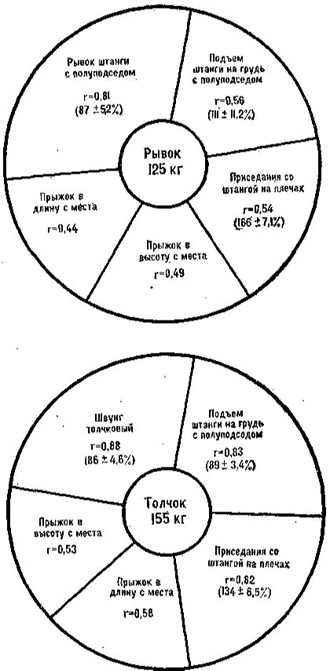
- Snatch: power snatch r = 0.81; power clean 0.56; squat 0.54; long jump 0.49; high jump 0.44. So jumps cannot be a main training means.
- Clean and jerk: push jerk 0.88, power clean 0.83, squat 0.82; long jump 0.58, high jump 0.53.
- Model for a 280 kg total (125 + 155 kg). As % of the snatch: power snatch 87 ± 5.2%, power clean 111 ± 11.2%, squat 166 ± 7.1%. As % of the clean and jerk: push jerk 86 ± 4.6%, power clean 89 ± 3.4%, squat 134 ± 6.5%. Falling short of a model value shows which quality needs work in the plan.